← Back to homepage
Hyperthermia & MR-Guided Therapy
Heating tumours precisely to make radiotherapy and chemotherapy more effective
Hyperthermia is the controlled heating of a tumour to about 39–44 °C. At these temperatures cancer cells become more sensitive to radiotherapy and chemotherapy, so hyperthermia is given in combination with those treatments rather than on its own.
Our work covers the whole chain from applicator design and patient-specific treatment planning to MR-guided temperature monitoring and clinical implementation, with a particular focus on deep hyperthermia in the head and neck.
What Is Hyperthermia?
In radiofrequency (RF) and microwave hyperthermia, an array of antennas around the patient deposits electromagnetic energy in the tumour. The main challenge is control: the tumour must reach therapeutic temperatures while healthy tissue, and especially critical structures such as the spinal cord or brain, stays safe. Clinical studies have shown that the thermal dose achieved in the tumour predicts the outcome, for example local control in cervical cancer treated with radiotherapy and hyperthermia.
Achieving a good thermal dose is hardest in anatomically complex regions. The head and neck region is a clear example: tumours lie close to critical tissues, and the anatomy, cooling by blood flow and tissue properties vary strongly between patients.
Deep Hyperthermia in the Head and Neck
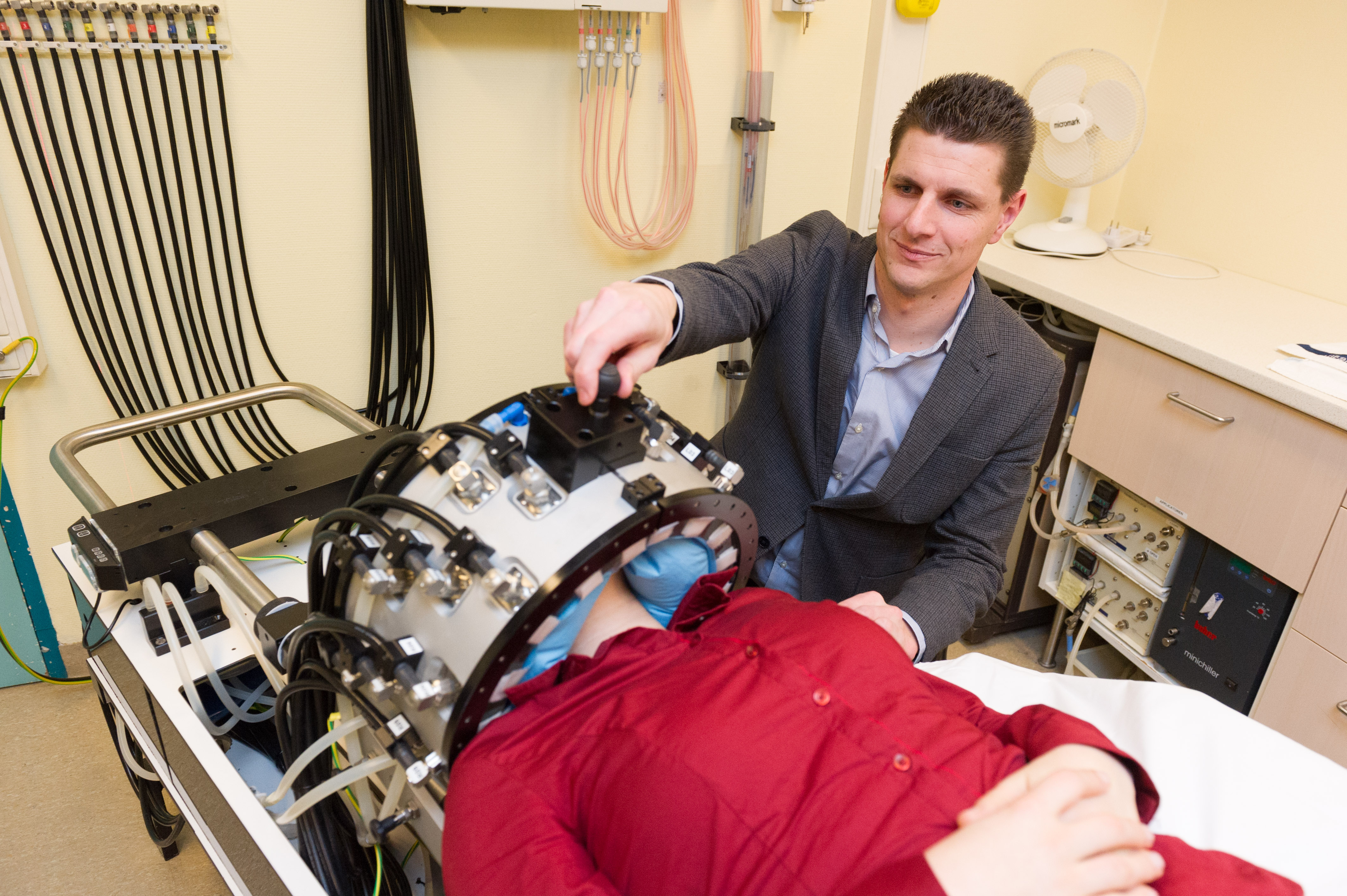
Deep hyperthermia in the head and neck was long considered impractical. During his PhD at Erasmus MC, Maarten Paulides designed the HYPERcollar, the first phased-array applicator for deep hyperthermia in this region. Its design was driven by electromagnetic simulation rather than trial and error. The first clinical treatments showed that patient positioning and temperature measurement were new challenges in their own right.
These lessons led to the redesigned HYPERcollar3D, in clinical use at Erasmus MC since 2015. Clinical studies have since reported the feasibility of deep head and neck hyperthermia combined with radiotherapy and outcomes after re-irradiation with hyperthermia. The technology is being brought to more hospitals through the medtech company Sensius, which Maarten Paulides co-founded, and is being evaluated further in the TANCA-I phase I trial.
Treatment Planning in the Clinic
Hyperthermia treatment planning uses a 3D patient model built from CT and MRI to predict where energy is absorbed (the specific absorption rate, SAR) and how the tissue heats. We contributed to implementing treatment planning in routine clinical hyperthermia in Rotterdam and to VEDO, a software tool that brings planning into the treatment room so that heating can be adapted in real time, for example when a patient reports a hot spot.
Planning also guides device design and applicator selection, and planning-based quality indicators help predict treatment quality. Read more on Computational Medicine.
MR-Guided Hyperthermia and MR Thermometry
Invasive temperature probes only measure at a few points. MR thermometry, based on the proton resonance frequency shift (PRFS), makes it possible to measure temperature non-invasively in 3D during treatment. We develop MR-compatible applicators such as the MRcollar for the head and neck, dual-function hardware that both heats and images, and methods that correct MR thermometry for motion and susceptibility artefacts.
Together with partners in the Netherlands and Germany, we assessed MR thermometry accuracy across institutions and MR-guided hyperthermia systems, developed imaging-based patient selection for MR-guided hyperthermia in cervical cancer, and evaluated MR thermometry in soft-tissue sarcoma with LMU Munich. Combining MR measurements with models and feedback control is the basis for adaptive hyperthermia. See Medical Imaging.
Representative Publications
Feasibility, SAR Distribution, and Clinical Outcome upon Reirradiation and Deep Hyperthermia Using the Hypercollar3D in Head and Neck Cancer Patients
Kroesen M, …, Paulides M · Cancers, 2021
DOI: 10.3390/cancers13236149
The Clinical Feasibility of Deep Hyperthermia Treatment in the Head and Neck: New Challenges for Positioning and Temperature Measurement
Paulides MM, …, van Rhoon GC · Physics in Medicine & Biology, 2010 · Roberts Prize
DOI: 10.1088/0031-9155/55/9/003
Experimental Validation of the MRcollar: An MR Compatible Applicator for Deep Heating in the Head and Neck Region
Sumser K, …, Paulides MM · Cancers, 2021
DOI: 10.3390/cancers13225617
Dual-Function MR-Guided Hyperthermia: An Innovative Integrated Approach and Experimental Demonstration of Proof of Principle
Sumser K, …, Paulides MM · IEEE Transactions on Biomedical Engineering, 2021
DOI: 10.1109/TBME.2020.3012734
MR Thermometry Accuracy and Prospective Imaging-Based Patient Selection in MR-Guided Hyperthermia Treatment for Locally Advanced Cervical Cancer
VilasBoas-Ribeiro I, …, Paulides MM · Cancers, 2021
DOI: 10.3390/cancers13143503
Evaluation of Magnetic Resonance Thermometry Performance During MR-Guided Hyperthermia Treatment of Soft-Tissue Sarcomas in the Lower Extremities and Pelvis
Karkavitsas SN, …, Paulides MM · International Journal of Hyperthermia, 2024
DOI: 10.1080/02656736.2024.2405105
Integrated Thermal and Magnetic Susceptibility Modeling for Air-Motion Artifact Correction in Proton Resonance Frequency Shift Thermometry
Nouwens SAN, …, Paulides MM · International Journal of Hyperthermia, 2022
DOI: 10.1080/02656736.2022.2094475
Clinical Performance and Future Potential of Magnetic Resonance Thermometry in Hyperthermia
Feddersen TV, …, Paulides MM · Cancers, 2021
DOI: 10.3390/cancers13010031
Simulation Techniques in Hyperthermia Treatment Planning
Paulides MM, Stauffer PR, Neufeld E, …, van Rhoon GC · International Journal of Hyperthermia, 2013
DOI: 10.3109/02656736.2013.790092
All selected publications
Frequently Asked Questions
What is hyperthermia in cancer treatment?
Hyperthermia is the controlled heating of a tumour to about 39–44 °C, usually with radiofrequency or microwave energy. It makes cancer cells more sensitive to radiotherapy and chemotherapy and is therefore applied together with these treatments.
Can tumours in the head and neck be treated with hyperthermia?
Yes. The HYPERcollar3D, developed by Maarten Paulides and colleagues, enables deep hyperthermia in the head and neck and has been in clinical use at Erasmus MC since 2015. Patient-specific treatment planning is used to focus the heat on the tumour while protecting critical tissues.
What is MR-guided hyperthermia?
In MR-guided hyperthermia, the patient is heated inside an MRI scanner so that the temperature can be measured non-invasively in 3D during treatment (MR thermometry). This allows the heating to be adapted to the individual patient.
Where can patients get hyperthermia treatment?
Maarten Paulides is an engineer and does not treat patients. Questions about treatment should go to the treating physician or the Hyperthermia Unit of the Erasmus MC Cancer Institute. See the information for patients (Dutch).