← Back to homepage
Neuromodulation
Influencing brain activity without surgery, guided by personalised models
Neuromodulation influences the activity of neurons with electric, magnetic or acoustic energy. Deep brain stimulation is effective but requires implanting electrodes through surgery. Non-invasive techniques stimulate the brain through electrodes or transducers on the scalp instead.
We use imaging, computational head models and measurements to make non-invasive stimulation more targeted and more personal, with drug-resistant epilepsy as a key application.
Personalised Stimulation for Epilepsy
About a third of people with epilepsy continue to have seizures despite medication. Transcranial direct current stimulation (tDCS) is a non-invasive option, but its effect depends strongly on where the current flows in each individual head. Together with Kempenhaeghe and the 4Brain lab of Ghent University Hospital, we developed a data-driven workflow that uses each patient's MRI and EEG to personalise the electrode montage and target the epileptic focus.
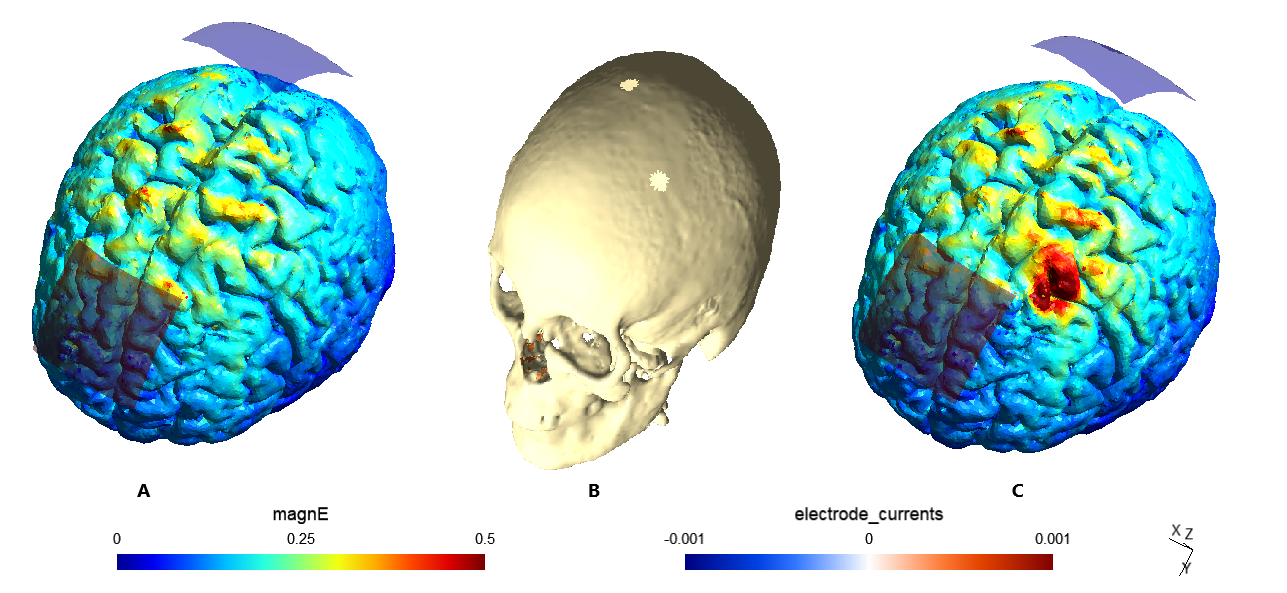
Because many patients with refractory epilepsy have had brain surgery, we also study how skull defects such as burr holes change the current flow, and we built a three-layer MRI-based head phantom to validate transcranial electrical stimulation simulations experimentally. This work is the subject of the PhD thesis of Steven Beumer on the benefit of personalising tDCS in refractory epilepsy (TU/e, 2026).
Temporal Interference Stimulation
Conventional transcranial stimulation is strongest at the surface of the brain. Temporal interference (TI) stimulation combines two high-frequency electric fields with a slightly different frequency. Where they overlap, they create a low-frequency envelope that can modulate neurons deeper in the brain, potentially without affecting the tissue in between.
We published a systematic review of all experimental studies of transcranial temporal interference stimulation in humans, co-authored in-human evidence for TI neuromodulation, and analyse how uncertainty in tissue conductivities affects the field that reaches the target.
Models, Uncertainty and New Modalities
Every stimulation plan depends on a model of the head, and every model has uncertain tissue properties. We use polynomial chaos expansion to quantify quickly how these uncertainties affect the stimulation, for electrical stimulation as well as low-intensity focused ultrasound. Related work covers wireless power transfer and communication for brain implants, including near-field dosimetry of implant antennas, and simulation platforms for spinal cord stimulation.
The modelling approach is shared with our work in Computational Medicine and Model Inference & Calibration.
Representative Publications
Systematic Review of Experimental Studies in Humans on Transcranial Temporal Interference Stimulation
Mansourinezhad P, …, Paulides MM · Journal of Neural Engineering, 2025
DOI: 10.1088/1741-2552/ae0524
Personalized tDCS for Focal Epilepsy: A Data-Driven Workflow Based on Imaging and EEG Data
Beumer S, …, Mestrom RMC · Brain Sciences, 2022
DOI: 10.3390/brainsci12050610
Exploiting Polynomial Chaos Expansion for Rapid Assessment of the Impact of Tissue Property Uncertainties in Low-Intensity Focused Ultrasound Stimulation
Sumser K, Mestrom R, Tuysuz YE, Paulides MM · Bioelectromagnetics, 2025
DOI: 10.1002/bem.70004
All selected publications
Frequently Asked Questions
What is temporal interference stimulation?
Temporal interference (TI) stimulation applies two high-frequency electric fields with slightly different frequencies through scalp electrodes. Where the fields overlap they produce a low-frequency envelope that can modulate neurons, which may allow deeper brain regions to be targeted non-invasively.
Can non-invasive brain stimulation help in epilepsy?
Non-invasive stimulation such as tDCS is being studied as a treatment option for people with drug-resistant epilepsy. Its effect depends on the individual head anatomy, which is why we personalise the stimulation using each patient's MRI and EEG.
Does Maarten Paulides treat patients with epilepsy?
No. He is an engineer and scientist. Patients should contact their treating neurologist or an expertise centre such as Kempenhaeghe. See the information for patients (Dutch).