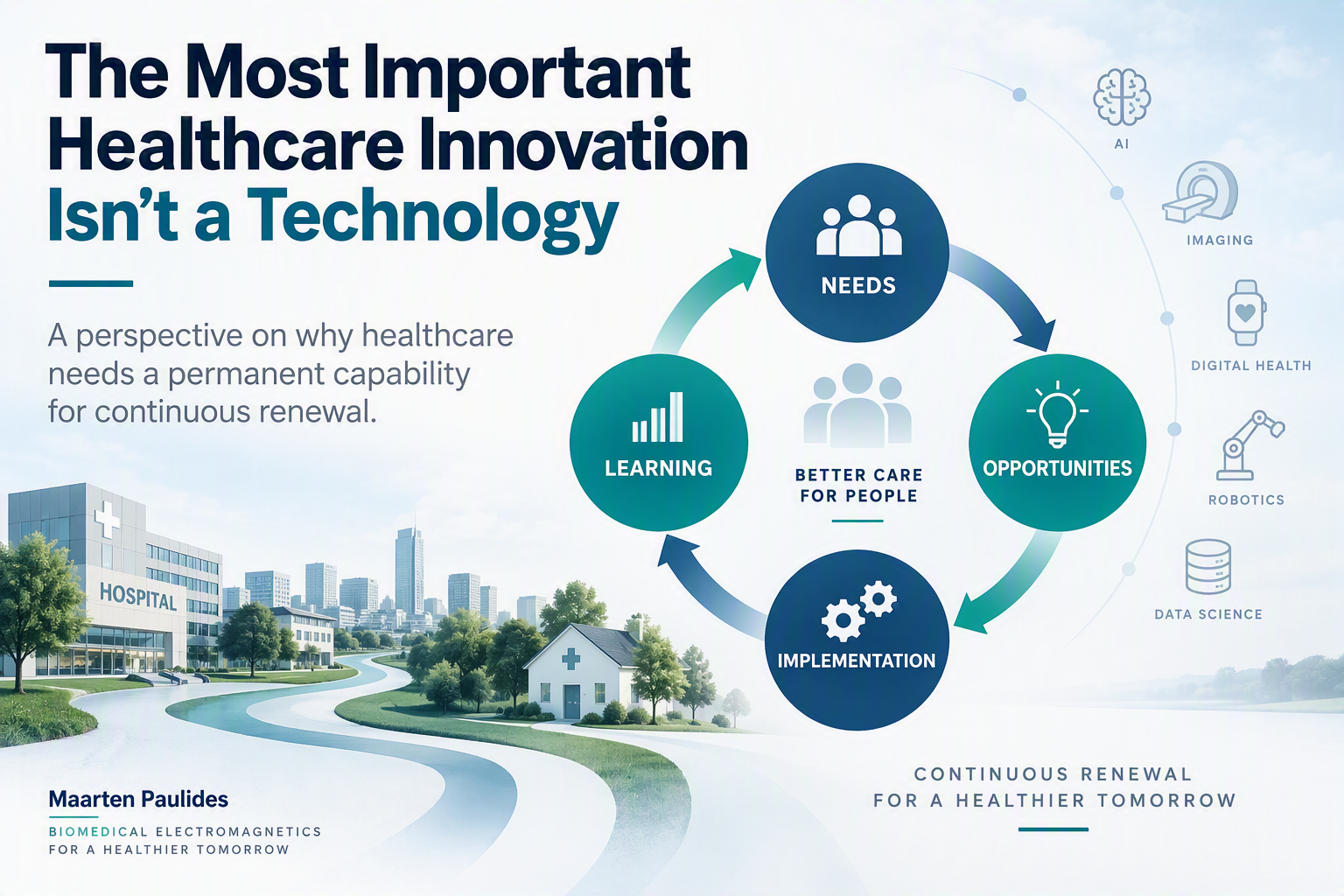
Every few years, healthcare is confronted with a new wave of innovation. Today much attention is directed towards artificial intelligence. Before that came digital health, remote monitoring and precision medicine. Robotics, autonomous diagnostics, advanced sensing technologies and continuous feedback systems are likely to follow.
Each wave promises to improve healthcare. Yet each wave exposes the same weakness. Healthcare has become remarkably good at delivering care, but remains surprisingly poor at renewing itself.
Healthcare is entering a fundamentally different era. During much of the twentieth century, healthcare organizations operated in a relatively stable environment. Medical knowledge advanced steadily, while organizational change remained comparatively slow. Today, technological progress, workforce shortages, increasing demand and financial pressures interact continuously. Adaptation is no longer an occasional challenge. It is becoming a permanent requirement.
Innovation is often framed as a technology problem. We focus on algorithms, devices, software platforms and treatments. Yet most opportunities for improvement originate in daily practice. Clinicians, nurses, technicians, patients and caregivers are continually frustrated by fragmented care pathways, unnecessary variation, inefficiencies and unmet needs. Healthcare does not suffer from a lack of problems to solve. It suffers from a limited ability to systematically convert those problems into solutions while learning from the results.
At the same time, science and engineering continuously generate new opportunities. Some emerge directly from clinical needs. Others originate from curiosity-driven research long before practical applications become apparent. Many transformative technologies emerged in exactly this way. The future therefore belongs neither to need-driven nor discovery-driven innovation alone. It belongs to organizations capable of continuously connecting emerging needs with emerging opportunities.
The primary barrier to innovation is often not scientific discovery but organizational learning. Hyperthermia, MR-guided therapy and neuromodulation, applications that I am active in as a researcher, illustrate the same challenge. Significant technological progress has been achieved in all three fields, yet clinical impact depends on training, workflow redesign, quality assurance, reimbursement, implementation and continuous learning. The technology changes, but the underlying challenge remains remarkably similar.
Innovation and implementation are therefore not separate phases. Implementation frequently generates new scientific questions. Clinical practice reveals unexpected effects, failures, opportunities and knowledge gaps that cannot be identified in laboratories alone. Every intervention creates an opportunity to learn. Knowledge drives implementation, but implementation also generates knowledge.
Despite this, most healthcare organizations remain structured around care delivery rather than continuous renewal. They have departments for finance, operations, human resources, information technology and quality management. Few have developed an equivalent capability for systematically identifying opportunities, evaluating solutions, implementing improvements and learning from outcomes. Renewal therefore depends heavily on temporary projects, enthusiastic individuals and short-term funding. Valuable lessons are generated but often remain local and disappear when projects end.
This limitation becomes increasingly problematic as the pace of change accelerates. Artificial intelligence, remote monitoring, robotics and future healthcare technologies will not arrive one at a time. Healthcare organizations will increasingly face multiple overlapping innovations simultaneously. The key question is no longer whether healthcare should innovate. The question is whether healthcare can develop a permanent capability for renewal.
Such a capability would continuously identify challenges emerging from practice, connect them to available opportunities, implement solutions, evaluate outcomes and learn from the results. Some problems will require organizational redesign. Others can be solved with existing technologies. Only a minority will require entirely new scientific research. The objective is not to maximize innovation. The objective is to maximize improvement.
Increasingly, this challenge extends beyond individual hospitals. Patients move between home environments, primary care, diagnostic services, hospitals, rehabilitation facilities and digital platforms. Many of the most important improvements of the coming decades may therefore arise from better integration of these environments rather than from individual technologies. Technology will continue to evolve, but its value will increasingly depend on how well it improves the performance of the entire care pathway.
Technical universities occupy a unique position in healthcare innovation. Their contribution extends beyond scientific discovery. They educate engineers who are trained to navigate both the world of knowledge generation and the world of implementation. While medical and life science research often focuses on understanding biological mechanisms, engineering focuses on designing interventions that function in real-world systems. This combination is particularly relevant as healthcare increasingly requires continuous adaptation. The challenge is no longer only to develop new technologies, but to integrate them effectively into clinical practice. Technical universities are therefore well positioned to contribute not only to innovation itself, but also to the mechanisms through which healthcare systems learn, adapt and improve.
This perspective also explains my own interest in healthcare. Technology is fascinating, but it is ultimately a means rather than an end. The real objective is to improve access to healthcare and reduce unnecessary differences in health outcomes between people and populations. Scientific progress has transformed countless lives, yet substantial inequalities remain, both within and between countries. The value of innovation in my view is therefore determined not by its novelty but by its contribution to human wellbeing.
A final question remains. If continuous renewal becomes essential to healthcare, who is responsible for it, and who pays for it? Core functions cannot depend indefinitely on temporary grants, isolated pilots or exceptional individuals. They require infrastructure, governance, expertise and sustainable funding. Society once recognized that quality improvement could not remain an informal activity and had to become an institutional responsibility. Continuous renewal may require a similar transition.
The twentieth century was largely concerned with building healthcare systems capable of delivering care at scale. The twenty-first century may be about building healthcare systems capable of continuously renewing themselves. The organizations that succeed will not necessarily be those that invent the most technologies. They will be those that become best at identifying emerging needs, recognizing emerging opportunities, learning from implementation and continuously translating both into better care.